Sorry, Not Sorry — The Words That Are Shrinking Us
Rawan Bazzari
4/13/20263 min read
As I was walking my cat – yes, I walk my cat, don’t judge or do, I am not justifying myself – this car sticker stopped me, as a matter of fact, it irritated me. The sticker says “Please be patient, I am just a girl”. What a shame!
Why do we, women, find ourselves apologizing randomly all the time? Most of us are not even aware of it, until it surfaces because we have read about it or someone brought it up. Yet again, this is another global phenomenon; it is not country or culture or region specific. Women’s issues seem to be universal, I am not sure if this is consoling or fundamentally disturbing.
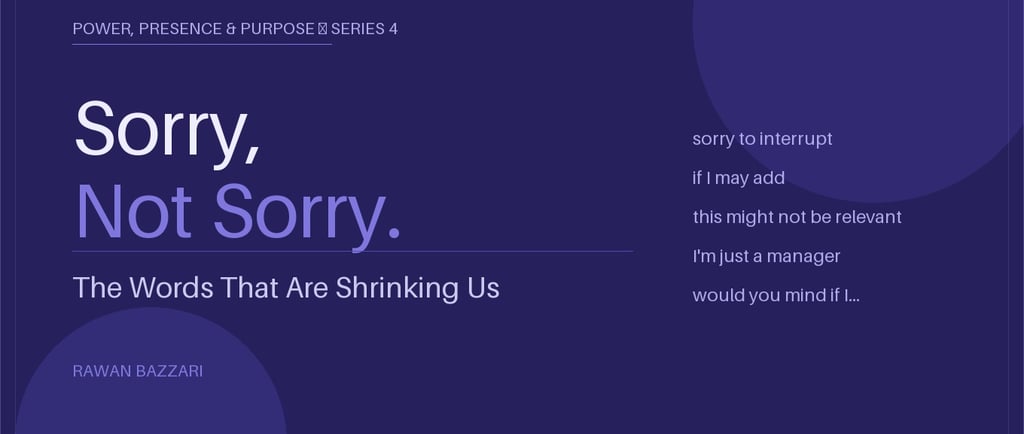
Women are mitigating their speech in both social and professional contexts; we find ourselves justifying the point we are about to make, asking for permission or apologizing for having an opinion at all. Phrases like "sorry to interrupt," "if I may add," "this might not be relevant" are textbook examples of the double-voiced discourse.
What is double-voiced discourse in this setting? When women address their audience, they reflect two contradicting factors: the first one is their own professional voice, carrying real content, expertise and determination. The second one mirrors the internalized address of femininity and workplace gender norms, which demands that women signal deference, non-threat, and smallness before claiming space; you do not want to be perceived as aggressive or opinionated, God forbid.
Research captures how women tend to hedge, speak indirectly and use mitigating language to soften our claims. Women in the workplace would often use polite expressions like "Would you mind," "I think," or "It would be great if" in email messages and conversations. Politeness, while cordial and non-confrontational, also serves to diminish the authority of the speaker. Women feel compelled to undermine the weight of their own communication, often overcompensating for fear of being labelled overbearing or bossy. We are even apologizing for our driving skills.
Why do we do this? Is it part of our genetic composition or is it a defense mechanism? It is an ingrained characteristic that we have adopted over the years in response to a social and professional environment that undermines women’s voices and stature. Women are twice as likely to be interrupted and to hear comments on their emotional state. Years of data show that women experience microaggressions at a significantly higher rate than men, including having their judgment questioned in their area of expertise, being mistaken for someone at a lower level, and having people express doubt or disbelief at their accomplishments.
The data confirms what many of us have felt. An experimental study on why women understate their performance — even when they know it is strong — found that women consistently rated their performance on a test lower than men did. It is not due to a lack of confidence; it is the outcome of the frames and norms imposed on us by society. These are the same norms that produce sentences like "I'm just a manager". Yes, we are the best consumers of the word “just” when presenting ourselves.
This is not okay; I refuse to accept this as how it should be. It is not. Women are highly competent; we do not need to seek validation for our professional contributions and opinions. We work hard — harder than men — to gain the knowledge and expertise in our fields. This applies to social skills as well, and it is time we work just as hard to stop using double-voiced discourse.
How do we start? How do we realize that we are undermining ourselves in the first place? What strategies and practices should we adopt to make our voices heard because they are worthy and have added value? How do we create our own value propositions?
In my upcoming training, "Power, Presence & Purpose: Advancing Women into Senior Leadership," we address exactly this: the language of shrinking. The permission words, the unnecessary apologies, the quiet knock before we dare to enter. Through practical exercises and intentional practice, we begin the work of unlearning what was never ours to carry in the first place — and reclaiming the voice that was always worthy.
Contact
Let's connect and grow together.
Phone
rawan@rawanbazzari.com
+962-79-536-9032
© 2026. All rights reserved.